

Equipping small-to-medium vessels such as day cruisers, cuddy boats, pocket yachts, and commercial craft with reliable climate control requires careful consideration of space, cooling capacity, and power consumption. Compact cabins can experience significant solar heat gain, while installation space is often limited to under-berth lockers, seating bases, or bilge compartments.
For vessel owners, marine equipment distributors, and boat builders, selecting the right system means balancing BTU capacity, physical footprint, and electrical demand. An oversized unit may cycle too frequently, while an undersized system may struggle to maintain the desired temperature. Inverter technology and compact system design can help address these constraints while supporting more flexible vessel layouts.
Calculating the Right BTU Capacity for Compact Cabins
Thermal loads on boats can vary according to cabin volume, window area, insulation, passenger occupancy, and local climate conditions. When selecting a small air conditioner for boat applications, these factors should be considered together rather than relying on cabin size alone.
For smaller enclosed berths and compact cabins, systems around 9,000 BTU may provide a suitable starting point depending on the actual heat load. Larger cabins, pilothouses with extensive glazing, or spaces with higher occupancy may require 12,000 BTU or more, particularly in hot and humid climates. A vessel operating in the Middle East, for example, may experience a different cooling load from a similar boat used in a milder European coastal environment.
Proper sizing also supports effective humidity removal, which is important for protecting upholstery, electronics, and interior fittings. Buyers should therefore consider both temperature control and moisture management when comparing different capacity options. For distributors, understanding these application differences can also make it easier to match product specifications with different vessel types and customer requirements.
Optimizing Physical Footprint and Structural Durability
Space is often one of the main limitations when installing air conditioning on smaller vessels. Integrated systems combine key refrigeration components within a single chassis, reducing installation complexity and making them suitable for confined areas such as lockers, seating bases, and bilge compartments. A compact configuration can also simplify equipment planning when available machinery space is already occupied by batteries, pumps, electrical equipment, or other onboard systems.
Noise and vibration are also important when equipment is installed close to sleeping or living areas. Appropriate compressor mounting and vibration isolation can help reduce operating noise during overnight use. This is particularly relevant for private yachts and smaller commercial vessels where the air-conditioning unit may be installed near occupied cabin spaces.
Material selection also plays an important role in long-term durability. Full-titanium alloy coaxial condensers offer strong resistance to saltwater corrosion, while 304 stainless steel chassis and drain pans provide additional protection against moisture. Suitable water-resistant protection for electrical components can further reduce the risk of moisture-related failures in demanding marine environments. These construction details are especially relevant for buyers operating vessels in high-humidity or high-salinity conditions.
Managing Power Draw with Inverter Technology
Power consumption becomes particularly important for vessels that rely on battery banks, generators, or solar-assisted electrical systems. Fixed-speed compressors can create high starting currents, placing additional demand on onboard electrical equipment. For smaller vessels with limited electrical capacity, the starting characteristics of an air conditioner should therefore be considered alongside its nominal cooling capacity.
Variable-frequency inverter technology gradually adjusts compressor speed according to cooling demand, helping reduce starting-current demand and unnecessary cycling. This approach can support more efficient operation across AC 110V/220V systems and DC 12V/24V/48V configurations.
For vessels using lithium battery banks, inverter marine air conditioners can also provide greater flexibility during off-grid operation. By adjusting output rather than repeatedly switching the compressor fully on and off, the system can better match cooling output with the actual cooling requirement and support more controlled energy use. Compatibility with generators, batteries, and solar-supported power systems can also give distributors more options when specifying equipment for different vessel architectures.
Featured Solution: Integrated Inverter Marine HVAC Platforms
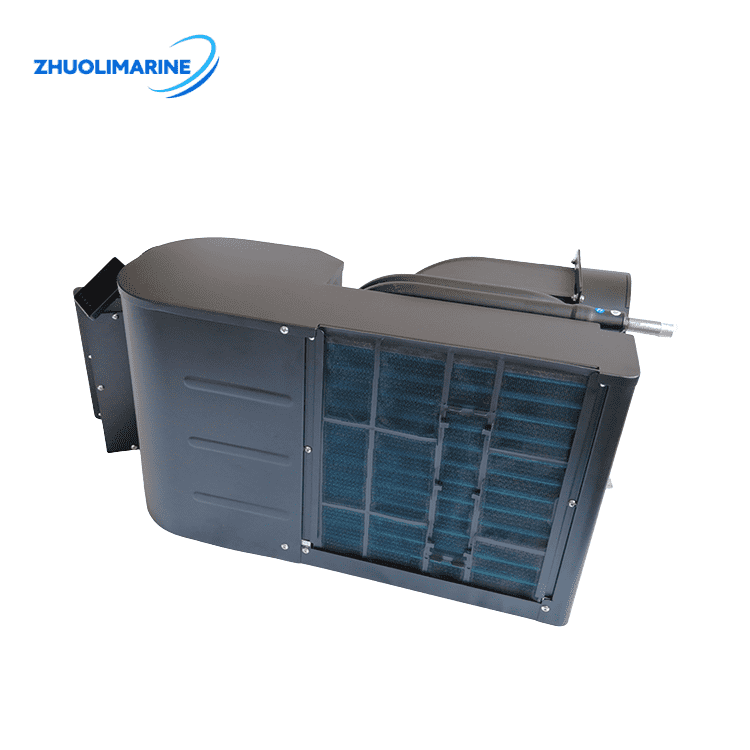
For distributors, brand partners, and commercial boat builders, ZhuoliMarine’s inverter marine air conditioner range includes models from 9,000 BTU to 25,000 BTU. Available in AC 110V/220V and DC 12V/24V/48V configurations, these systems are designed for vessels where installation space and electrical capacity are limited.
The units combine variable-frequency inverter technology with full-titanium alloy coaxial condensers and 304 stainless steel chassis with an integrated drain pan. Their compact design supports installation in confined areas, while Wi-Fi app control provides convenient remote temperature adjustment. Low-inrush operation is also suited to vessel power systems where managing startup demand is an important consideration.
For business buyers, warranty and technical support should also be considered during product selection. A 1-year warranty and dedicated technical support can provide additional assistance for distributors and vessel operators when products are installed across different vessel configurations and operating environments.
Partnering with ZhuoliMarine for Advanced Climate Solutions
As a specialized manufacturer of marine HVAC equipment, ZhuoliMarine supplies inverter climate systems for small-to-medium vessels, private yachts, commercial craft, and distribution partners. Its solutions combine corrosion-resistant construction, variable-frequency operation, and multiple voltage configurations for different marine applications.
For upcoming vessel projects or wholesale requirements, contact the ZhuoliMarine technical sales team to discuss suitable marine air conditioning solutions.


