

When procurement managers, regional distributors, and electronics service enterprises source maintenance equipment for professional repair operations, selecting the right toolkit involves a careful balance of versatility, material durability, and supply chain stability.
Modern electronic devices, ranging from smartphones, drones, and digital cameras to household appliances and desktop computers, require specialized fastening solutions that minimize stripping risks while maximizing technician efficiency on the workbench.
Navigating the diverse options available in the wholesale marketplace requires a structured evaluation of technical specifications, manufacturing capabilities, and design innovations.
Established tool manufacturers like Jakemy focus on producing reliable hand tools directly from source manufacturing facilities, offering B2B buyers a dependable avenue for sustainable hardware distribution and commercial collaboration.
Furthermore, evaluating distributor support programs helps organizations establish reliable supply channels that adapt quickly to evolving consumer and industrial repair demands.
Assessing Component Versatility and Bit Selection
A primary factor to analyze when selecting a professional toolkit is the breadth and composition of its bit inventory. Standard repair tasks frequently encounter diverse screw heads across various laptop models, tablets, and gaming consoles, making multi-bit systems indispensable for technicians.
Comprehensive kits address this challenge by housing extensive bit arrays within a single organized case, reducing the need for scattered individual drivers.
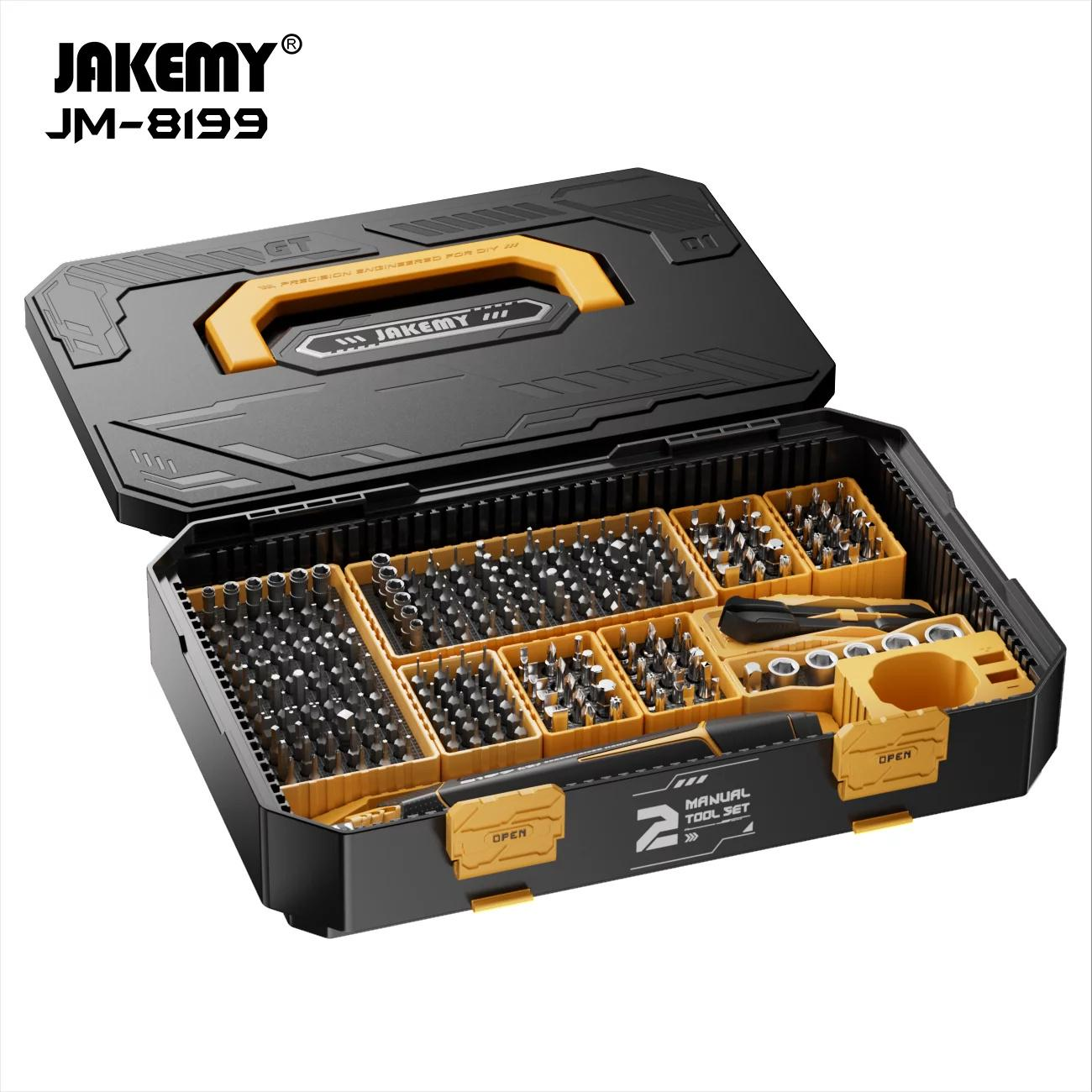
For instance, the jakemy jm-8199 integrates a robust 257-in-1 modular configuration that includes 252 precision bits tailored for multi-industry applications. Specifically, this array features 216 pieces of 28mm H4.0 chrome-vanadium (CR-V) phosphated bits alongside 36 pieces of 25mm H6.3 larger-format bits.
Evaluating the material composition of these bits remains crucial for long-term operational value and tool lifespan. High-grade CR-V steel treated with a phosphating finish offers enhanced resistance against surface rust and mechanical wear, supporting repeated high-torque applications in busy commercial repair workshops.
B2B procurement teams should review whether the bit selection aligns with their target market’s specific repair needs, ensuring that both delicate micro-screws in mobile electronics and heavy-duty fasteners in mechanical equipment are adequately accommodated.
Evaluating Ergonomics and Dual-Handle Innovations
Technician productivity is closely tied to the ergonomic design, weight distribution, and overall adaptability of the screwdriver handle. Prolonged daily repair sessions can lead to hand fatigue if the grip profile lacks proper contouring, anti-slip texture, or balanced weight.
Advanced toolkits frequently incorporate dual-handle systems to accommodate different torque requirements and workspace spatial constraints without sacrificing comfort.
The modular architecture of the jakemy jm-8199 features a patented 2-in-1 internal handle design where a smaller precision handle nests neatly inside an outer larger handle.
This innovative configuration supports both H4.0 and H6.3 bits without necessitating separate adapters, streamlining tool transitions during complex disassembly procedures.
Procurement teams should verify patent compliance and design authenticity—such as utility model patent number 2024206292939 and appearance patent number 2024304375487—to protect their distribution supply chain from intellectual property risks and substandard market knockoffs.
Manufacturing Scale, Quality Control, and Supply Reliability
For wholesale buyers and enterprise distributors, the operational reliability of the manufacturing source is just as critical as the individual tool specifications. Working directly with a source factory allows businesses to secure consistent product quality and predictable lead times without middleman markups.
Industrial production facilities equipped with more than 20 imported machinery units maintain stringent quality control thresholds, adhering to recognized international safety standards such as CE certification.
Logistics infrastructure and inventory holding capacity also dictate supply chain resilience during market fluctuations. Robust warehouse facilities capable of supporting up to 60 days of inventory storage with a total operational capacity of 8 million sets help mitigate stockout risks during peak demand seasons.
Furthermore, physical dimensions and transport metrics require careful consideration for international shipping efficiency. The jakemy jm-8199 storage box measures 300 by 210 by 60 millimeters with a single gross weight of 1.782 kilograms, while standard carton packaging organizes 10 sets per master carton measuring 44 by 32 by 31.5 centimeters with a gross weight of 18.3 kilograms.
Understanding these precise logistical footprints assists logistics coordinators in calculating container freight volumes and warehouse storage space accurately.
Customization Options for B2B Procurement Teams
Brand differentiation plays a vital role for regional distributors seeking to build proprietary market share in competitive tool sectors. Many enterprise clients look beyond off-the-shelf catalog items, preferring customized toolkits that reflect their unique corporate identity and brand positioning.
When partnering with Jakemy, wholesale buyers can explore flexible OEM and ODM services designed to tailor hardware packages to specific customer branding guidelines.
Customization parameters typically include nameplate logo printing, modular component adjustments to alter specific bit quantities, and personalized adhesive branding labels on packaging boxes.
Minimum order quantities (MOQs) for custom production runs generally start around 100 pieces, accommodating both regional distributors and large-scale enterprise buyers testing new product lines.
Sample production timelines typically span 7 to 14 days, followed by mass production cycles of approximately 20 days. Reviewing these manufacturing lead times during the initial procurement phase helps establish realistic inventory schedules for seasonal commercial distribution.
Conclusion
Selecting an appropriate precision toolkit requires a thorough evaluation of technical specifications, ergonomic utility, and supplier reliability.
By examining component breadth, material standards, manufacturing infrastructure, and customization flexibility, B2B procurement professionals can make informed purchasing decisions that elevate service quality, satisfy end-user demands, and support sustainable long-term business growth.
Additionally, analyzing warranty support terms and after-sales service policies provided by the manufacturer offers added peace of mind for long-term commercial partnerships.


