

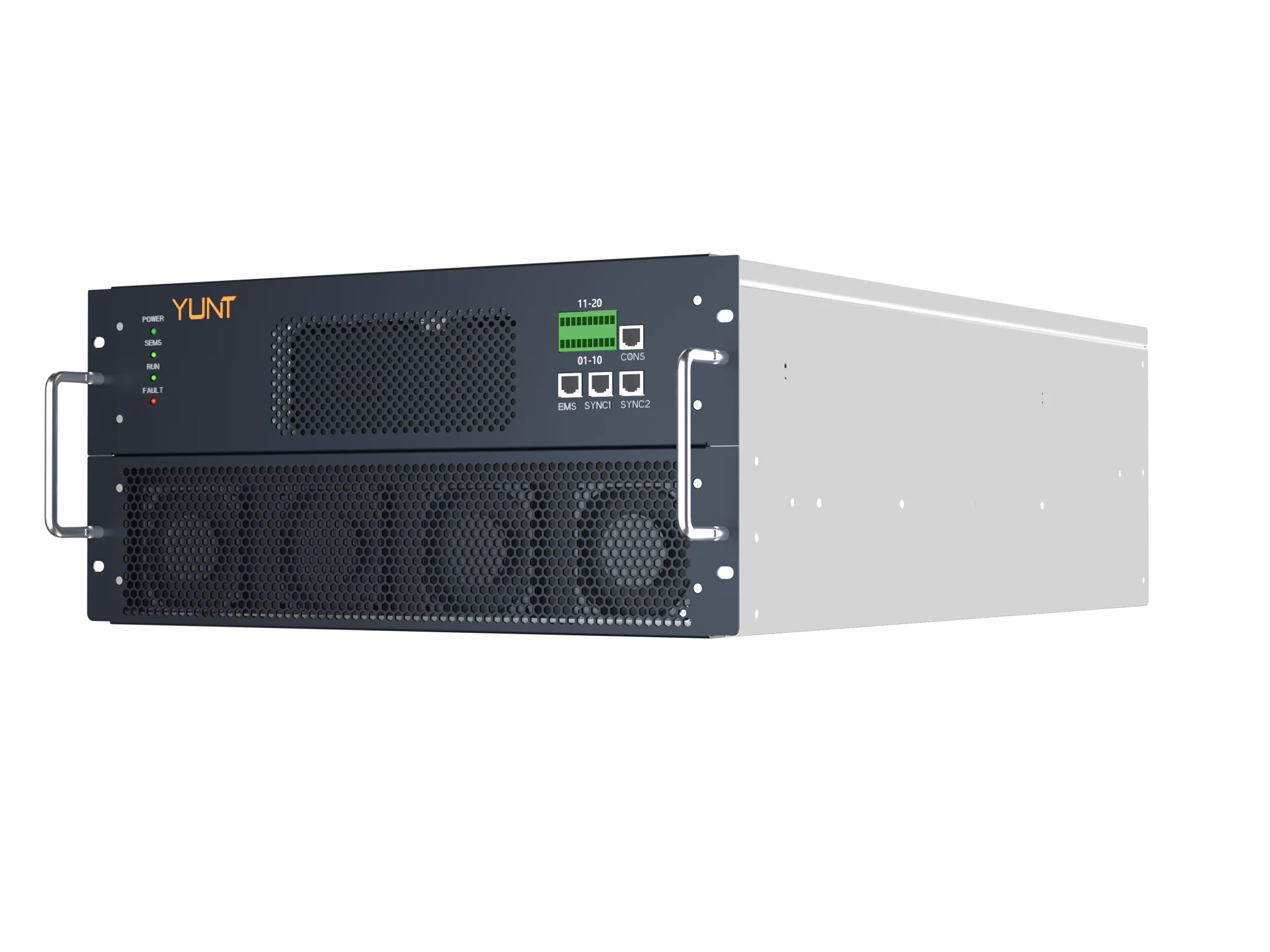
As commercial and industrial (C&I) energy storage projects become more demanding, system designers are looking beyond simply converting battery power into usable electricity. The power conversion architecture now affects scalability, grid compatibility, project integration, and long-term operation. That is why modular power conversion modules are gaining attention as an alternative to conventional inverter architectures.
But does replacing a traditional inverter always make sense? The answer depends on the project. For system integrators and EPC teams, the more useful question is whether a modular power conversion approach can provide the flexibility and control required by the specific application.
What Role Does a PCS Module Play?
A power conversion system (PCS) provides the bidirectional interface between the battery’s DC power and the AC side of an energy-storage system. During charging, AC power is converted to DC; during discharge, stored DC power is converted back to AC. The U.S. Department of Energy similarly identifies bidirectional power conversion as a core function in battery energy-storage systems.
A modular PCS takes this conversion function and packages it into scalable power units. Instead of relying on one large conversion unit for the entire system, integrators can configure multiple modules according to the required power architecture.
This distinction matters when project capacity, site conditions, or operating requirements may change over time.
Why Consider Modular Power Conversion Modules Instead of a Traditional Inverter?
The main consideration is not simply equipment size. It is how the conversion architecture fits the overall energy-storage system.
A modular approach can make capacity expansion more straightforward because multiple conversion units can operate together. YUNT’s PCS Module page specifically states that its modules support parallel expansion, while the product range includes 100 kW, 110 kW, and 125 kW air-cooled models and corresponding liquid-cooled versions.
For a system integrator, this can provide more options when matching conversion capacity to battery configuration and project requirements. It can also make the architecture easier to adapt across different C&I applications rather than designing every project around a single fixed conversion block.
However, the right choice still depends on the battery voltage, grid requirements, required power, cooling strategy, installation environment, and overall system architecture.
What Technical Features Should Project Designers Check?
A modular architecture is only useful when the individual conversion units can meet the project’s electrical requirements.
For example, YUNT‘s Mars-100KT, Mars-110KT, and Mars-125KT air-cooled PCS modules have a maximum DC voltage of 1,000 V and a DC operating range of 580–1,000 V. Their rated AC grid voltage is 400 V, with an allowable grid voltage range of 300–460 V and a rated frequency of 50/60 Hz. The published maximum efficiency is 98.90%.
The same series uses transformerless topology and supports intelligent air cooling. YUNT also offers the Mars-100KT-LP, Mars-110KT-LP, and Mars-125KT-LP liquid-cooled versions with the same published rated power levels and key electrical ranges.
These specifications give engineering teams concrete parameters to evaluate before selecting a conversion architecture. Rather than comparing products by headline power ratings alone, project teams should check whether the module’s voltage, current, thermal-management, protection, and communication characteristics match the rest of the system.
Can Modular PCS Support More Complex Grid Conditions?
Modern C&I storage systems may operate under conditions that require more than basic DC-to-AC conversion. Renewable integration, microgrids, backup applications, and weak-grid environments can introduce additional control requirements.
YUNT states that its Mars Series PCS modules support PQ, VF, and VSG operating modes, as well as high- and low-voltage ride-through, black-start capability, and off-grid parallel operation. These functions can be relevant when an energy-storage system needs to interact with different operating modes rather than simply exchange energy with a stable grid.
This aligns with the broader role of modern power electronics. The Department of Energy notes that advanced inverters can provide functions related to voltage and frequency support, power control, and operation during grid disturbances.
When Is the Modular Approach Worth Considering?
For C&I projects where scalability, configurable power capacity, and multiple operating scenarios are important, modular PCS architecture can be worth evaluating. It is particularly relevant when system integrators need a repeatable conversion platform that can be adapted to different battery configurations and project sizes.
YUNT positions its PCS modules for applications including energy-storage cabinets, containerized storage systems, microgrids, and renewable-plus-storage systems. The company also states that it provides customized solutions for system integrators and EPC partners.
The practical decision should therefore start with the project’s electrical and operational requirements rather than the assumption that one architecture fits every site.
A More Flexible Path for C&I Storage Design
Replacing a traditional inverter with modular conversion equipment is ultimately an engineering decision. When the project requires scalable power architecture, flexible integration, and advanced grid-support functions, a modular PCS can provide a useful alternative.
With its Mars Series PCS module portfolio, YUNT provides 100 kW, 110 kW, and 125 kW air-cooled and liquid-cooled options, giving system integrators a defined set of conversion platforms to evaluate for C&I energy-storage applications. For projects where modularity and application-specific configuration matter, this approach can help engineers build an architecture around the actual site requirements rather than forcing the project into a fixed inverter configuration.


