

Digital dentistry relies on precise physical translation of digital impressions. Restorative crowns, long-span bridges, surgical guides, and implant frameworks demand strict micron-level tolerances. Inaccuracies along prep margins compromise clinical fit and increase chairside adjustments.
Additive manufacturing technology is indispensable in modern dental laboratories. While early adopters used basic LCD units, high-volume facilities increasingly prioritize projector-based light engines. Projector technology offers superior light collimation and long-term optical stability.
Understanding what separates projector systems from alternative curing methods helps lab owners select equipment wisely. Integrating digital light projection into production workflows elevates accuracy, reduces material waste, and delivers consistent clinical results.
Technical Principles of a DLP Resin 3D Printer
A DLP resin 3D printer uses a digital micromirror device (DMD) to project patterned ultraviolet light directly onto liquid photopolymer resin, curing each layer in a single exposure. Unlike LCD-based systems that selectively transmit ultraviolet light through a liquid crystal mask, DLP technology employs millions of individually controlled micromirrors to direct light with high precision.
This direct reflection delivers concentrated energy without passage through absorbing layers. Direct projection maintains consistent light intensity across every pixel, ensuring complete photopolymer cross-linking. Curing behavior remains uniform whether printing delicate margins or master models.
Optical distortion remains minimal in direct projection systems. Because no masking screen degrades under continuous UV exposure, light output stays stable over years of operation, ensuring long-term repeatability for demanding clinical dental applications.
Furthermore, specialized light engines operating at a 385 nm wavelength provide targeted curing for biocompatible resins. This wavelength ensures sharp edge clarity and optimal conversion rates without causing unwanted yellowing or thermal distortion in sensitive materials.
Why Precision Matters in a DLP Dental 3D Printer
Operating a specialized DLP dental 3D printer transforms daily production workflows for crown and bridge restorations. Crisp pixel boundaries ensure critical cervical preps match CAD designs exactly, reducing internal binding and seating friction during try-ins.
Complex implant surgery requires surgical guides with flawless channel alignment. Projector-based curing maintains structural accuracy across long guide holes, allowing titanium sleeves to seat securely. Precise sleeve alignment prevents drill wobble during sensitive surgical procedures.
Removable partial framework models also demand tight geometric control. Microscopic deviations in clasp pathways or rest seats compromise retentive forces, causing manual grinding. Direct projection ensures intricate castable structures burn out cleanly without fitting errors.
Orthodontic aligner model production benefits equally from sharp surface reproduction. Smooth layer transitions prevent visible stair-stepping along tooth surfaces, allowing thermoformed aligners to snap comfortably onto teeth without causing localized tissue irritation or pressure points.
Optical Uniformity and Advanced Hardware Design
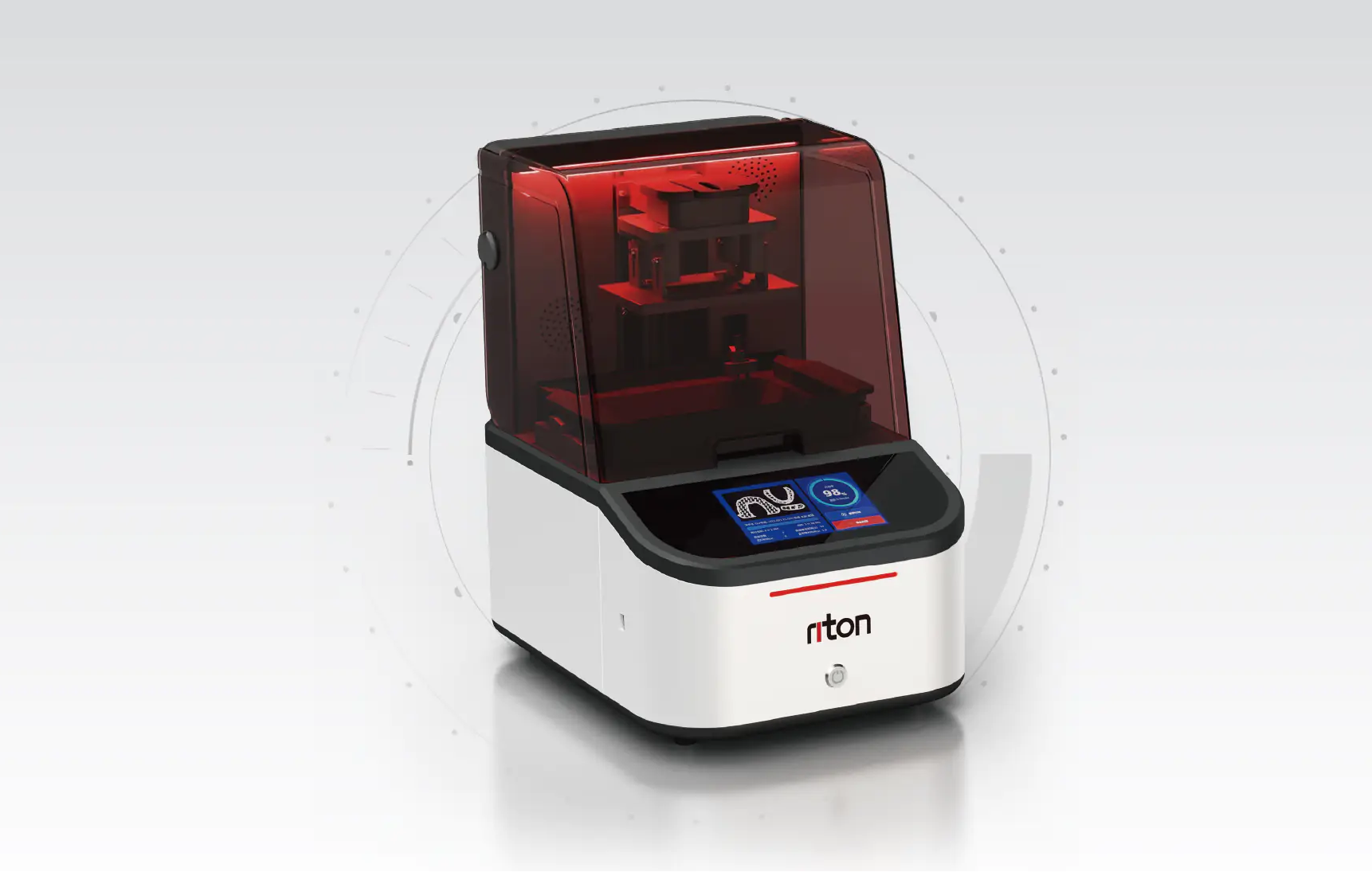
Achieving industrial reliability requires combining advanced optics with heavy-duty mechanical engineering. Systems developed by Riton, such as the RXDent-D130, demonstrate how specialized hardware design elevates dental manufacturing capabilities to meet demanding commercial standards.
The Riton RXDent-D130 incorporates a high-performance 385 nm DLP engine engineered for over 2,000 hours of continuous service. Adjustable light intensity ranging from 4 to 12 mW/cm² allows technicians to optimize curing energy for varied resin formulas.
An automated calibration module ensures light uniformity exceeding 95% across the build area. Broad uniformity reduces localized intensity drops near edges, guaranteeing components printed at peripheral positions match the exact dimensions of central parts.
Mechanical movement is governed by a P-class ball screw assembly that sustains ±0.01 mm positioning accuracy under load. Rigid Z-axis guidance prevents layer shift, ensuring consistent vertical alignment during rapid lift and retraction cycles.
Thermal Control and Automated Workflow Management
Maintaining stable resin temperature during printing is essential for controlling viscosity. The Riton RXDent-D130 features integrated dual heaters capable of reaching 45°C within five minutes, establishing optimal polymerization conditions before printing begins.
Active temperature regulation maintains constant resin fluidity, allowing photopolymer to flow smoothly across the vat floor after each lift cycle. Consistent viscosity prevents void formation and lowers peeling forces, protecting delicate support pins from fracture.
High-sensitivity force monitoring tracks peeling forces and release film wear in real time. Dynamic force feedback prevents mechanical stress from distorting soft green-state parts, extending film longevity while maintaining structural integrity across complex geometries.
Automated resin refilling systems further streamline continuous laboratory operation. Liquid sensors monitor resin levels continuously, topping off the vat automatically during lengthy print runs. Automated management reduces manual oversight and prevents job failures.
Operational Advantages and Material Efficiency
Deploying a DLP dental 3D printer improves overall laboratory efficiency and profit margins. High optical efficiency reduces required exposure times per layer, accelerating print turnover without increasing mechanical wear on components.
Material versatility expands significantly under precise light management. Systems handle biocompatible splint materials, castable waxes, gingiva masks, and custom impression trays with equal reliability, consolidating varied production onto a single, accurate machine platform.
Reduced remake rates directly save technician time and material expenditure. Delivering accurate models and restorations on the first attempt builds trust with clinical clients, preventing shipping delays and frustrating chairside fitting appointments.
Strategic Investment for Modern Dental Laboratories
Adopting digital light projection represents a forward-thinking investment for growing dental operations. Combining robust projector optics with rigid mechanical drive systems delivers predictable manufacturing performance capable of meeting tight turnarounds.
Choosing a dedicated DLP resin 3D printer enables laboratories to meet rising restorative demands confidently. Micron-level fidelity ensures physical output mirrors digital CAD designs with complete anatomical accuracy, supporting seamless clinical integration.
Through continuous hardware innovation and comprehensive service frameworks, Riton empowers dental professionals worldwide. Integrating advanced projection technology establishes a dependable foundation for operational efficiency, clinical success, and sustainable business growth.


