

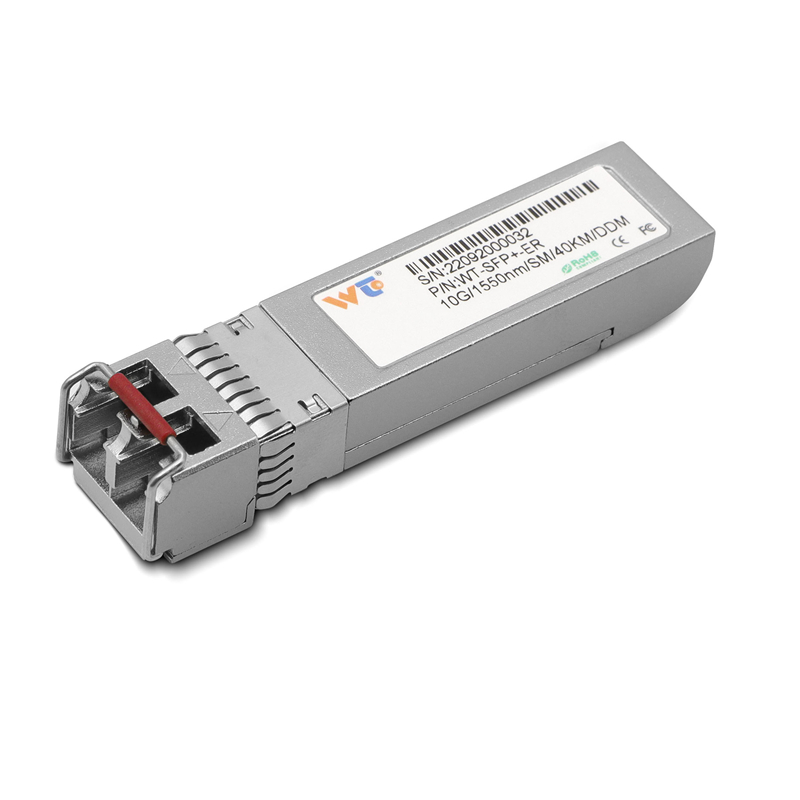
As network traffic grows, 10 Gigabit Ethernet provides a practical step up from conventional gigabit connections, supporting higher throughput for servers, switches, storage systems, and enterprise backbones. Understanding the terminology behind a 10G ethernet transceiver helps network engineers match optical interfaces to link distances, fiber infrastructure, and equipment requirements without paying for capabilities a deployment may never use.
What a 10G Transceiver Actually Does
A transceiver converts electrical signals from network equipment into optical signals for fiber transmission, then converts incoming optical signals back into electrical form. Installed in a compatible port, it provides the physical interface between a switch, router, server, or other network device and the transmission medium.
The term 10G refers to a nominal data rate of 10 gigabits per second. Many optical modules use the SFP+ form factor, which combines a compact physical design with support for 10 Gigabit Ethernet. Compatibility still depends on the host device, supported module specifications, firmware, and the relevant Ethernet standard.
Transceiver selection involves more than matching the data rate. Engineers must also consider connector type, wavelength, optical reach, fiber category, transmit power, receiver sensitivity, and operating temperature. A module may fit physically yet fail to establish a stable connection if its optical characteristics or host compatibility do not match the other endpoint.
Understanding SR, LR, ER, and ZR Designations
Optical reach categories help distinguish modules intended for different transmission distances. SR, or short reach, is commonly associated with multimode fiber and short connections such as links within data centers. Its actual supported distance depends on the fiber grade and the module’s specifications.
LR generally refers to long reach and is commonly used for 10G links over single-mode fiber across longer distances than short-reach modules. ER modules support extended-reach applications, typically beyond the range of LR modules, while ZR is commonly used for certain extended-reach implementations that may support even longer spans. ZR specifications can vary by vendor and implementation, so the designation alone should not be treated as a universal distance guarantee.
These categories also differ in optical budgets and deployment requirements. Longer-reach modules may have different transmit power, receiver sensitivity, and dispersion considerations. For a reliable design, the expected distance must be checked against the exact module datasheet, fiber loss, connector count, and any intermediate patch panels.
SFP+ Form Factors, Wavelengths, and Fiber Types
SFP+ describes the compact module form factor commonly used for 10 Gigabit Ethernet. It does not, by itself, identify the supported fiber type or transmission distance. Those details come from the optical standard and the particular module specification, making it important to distinguish the physical interface from the optical capabilities.
Wavelength determines how an optical signal interacts with the fiber and receiving optics. Short-reach multimode modules and single-mode LR or ER modules typically use different wavelength bands suited to their respective fiber types. Exact values depend on the implementation, and both ends must use compatible optical characteristics.
Fiber type adds another layer to the decision. Multimode fiber is often practical for shorter data-center links, whereas single-mode fiber supports longer distances and a wide range of network architectures. Connector formats also matter: LC connectors are common on SFP+ optical modules, while other interfaces may appear in different equipment configurations. A port, cable, and transceiver must all match.
Duplex and BiDi Modules: Two Ways to Carry Traffic
Conventional duplex fiber connections typically use two fiber strands, with one carrying transmitted signals and the other carrying received signals. This arrangement is widely used in SR, LR, ER, and ZR modules, and it makes the direction of each optical path straightforward to identify during installation and troubleshooting.
BiDi, short for bidirectional, allows transmission and reception over a single fiber strand by using different optical wavelengths in opposite directions. This can help make use of existing single-fiber infrastructure or reduce the number of fiber strands needed for a link. However, BiDi modules generally operate as matched pairs with complementary transmit and receive wavelengths.
The cost comparison should include the entire connection rather than the module price alone. BiDi can reduce fiber utilization in suitable environments, but compatible pairs and careful wavelength matching are essential. Duplex modules may be simpler where two strands are already available, particularly in networks with established patching and maintenance procedures.
Compatibility, Diagnostics, and Deployment Considerations
Before ordering a module, network teams should check the switch or server compatibility list, port speed, supported coding, and firmware requirements. Some devices accept a broad range of third-party optics, while others impose vendor-specific restrictions. Physical insertion into an SFP+ cage is not proof of functional compatibility.
Link troubleshooting benefits from checking both optical and network-layer conditions. Digital diagnostic monitoring (DDM), where supported, can provide readings such as temperature, supply voltage, transmit power, and receive power. These values help identify weak optical signals, dirty connectors, damaged fiber, or other issues, although the availability and accuracy of diagnostics depend on the module and host platform.
WINTOP provides 10G SFP+ transceiver options for different optical networking requirements. Buyers should check each model’s supported reach, wavelength, fiber type, and host-device compatibility before deployment. Selection should be based on the exact model’s reach, wavelength, connector, optical budget, and host-device support rather than the product category alone.
Conclusion
A 10G ethernet transceiver is best understood through several connected specifications: data rate, form factor, optical reach, wavelength, fiber type, and compatibility with the host device. SR and LR cover many short- and medium-distance links, while ER, ZR, and BiDi options address other distance or cabling requirements.
Correct terminology makes procurement and network design more precise, but the final decision still depends on the actual link budget and equipment environment. WINTOP supplies 10G optical connectivity options for a range of network layouts, giving engineers specifications to compare against project requirements. Contact WINTOP to identify a suitable transceiver configuration for a planned deployment.


