

Network administrators often face the challenge of upgrading infrastructure without completely overhauling legacy systems. The engineering behind Category 5e cabling allows for a seamless transition, enabling modern 5e cable speed capabilities to coexist with older standards. This integration is not accidental; it relies on precise physical mating and intelligent protocol negotiation. By understanding the mechanics of IEC 60603-7 connectors and the physics of signal transmission, IT professionals can optimize mixed-generation environments. This article explores how Cat5e maintains performance while interfacing seamlessly with Cat5 and Cat3 hardware.
The Mechanics of Pin-for-Pin Physical Compatibility
The foundation of backward compatibility rests on the standardized RJ45 interface. Strict adherence to mechanical geometry ensures that modern cabling mates securely with legacy ports without physical damage or signal discontinuity.
RJ45 Interface Standards and Connector Geometry
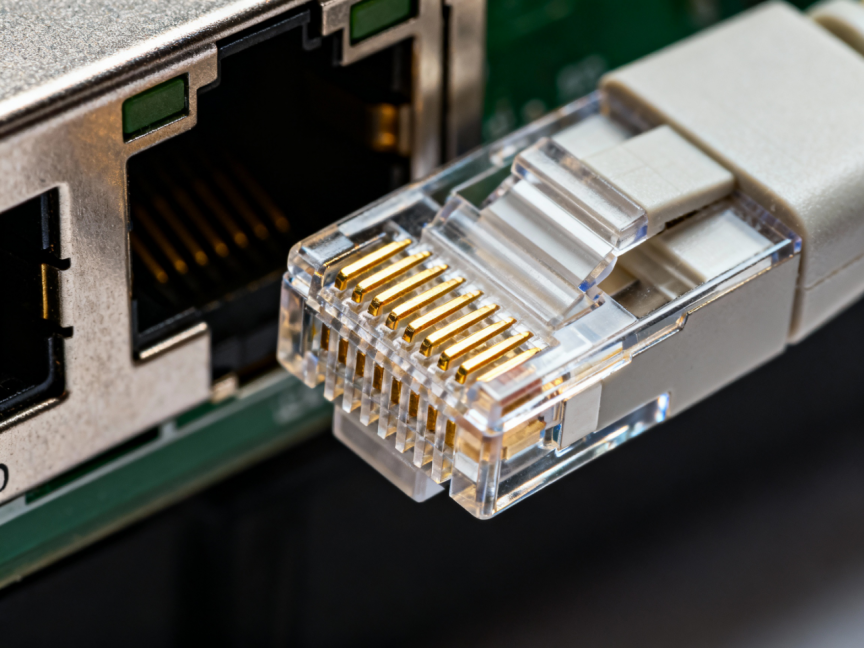
The IEC 60603-7 standard defines the mechanical dimensions of the 8P8C (RJ45) connector, ensuring that a Cat5e plug fits physically into a Cat3 jack. While the external form factor remains constant, the internal contact blade alignment differs for solid versus stranded conductors to prevent intermittent connectivity. Furthermore, spring wire elasticity in the jack must retain sufficient tension to maintain contact with older, potentially worn plugs. This physical standardization allows category 5e cable speed potential to be realized even when routed through patch panels originally designed for lower-frequency applications, provided the contact resistance remains within milliohm tolerances. Gold plating thickness, typically 50 micro-inches, is crucial for preventing oxidation in these mixed-metal mating cycles.
T568A and T568B Wiring Schematic Continuity
Maintaining the correct pinout is critical for minimizing DC loop resistance and ensuring pair polarity. Both T568A and T568B standards map the four twisted pairs to the same pins across Cat3, Cat5, and Cat5e generations. The primary difference lies in the twist rate; Cat5e features tighter twists to mitigate crosstalk. However, electrically, the continuity remains identical. This pin-for-pin alignment ensures that when a 5e ethernet cable speed signal is transmitted, the receiving legacy device sees the expected voltage on the expected pins, even if it cannot process the higher frequency modulation. This continuity is essential for Power over Ethernet (PoE) applications where DC power traverses the same copper path.
Signal Integrity and Protocol Integration in Mixed Networks
Beyond physical mating, the network must electronically adapt to varying bandwidth capabilities. Auto-negotiation protocols and crosstalk mitigation strategies allow high-speed cabling to function reliably alongside slower 10BASE-T and 100BASE-TX devices.
Managing cat 5e ethernet cable speed via Auto-Negotiation
The IEEE 802.3u standard introduced auto-negotiation, enabling devices to declare their capabilities. A Cat5e link connected to a legacy hub uses Fast Link Pulses (FLP) to advertise gigabit capability. If the partner device only sends Normal Link Pulses (NLP), the system automatically downgrades to 10BASE-T. This ensures that the cat 5e cable max speed does not overwhelm the receiver. However, duplex mismatches can occur if one side is manually forced to full-duplex while the other auto-negotiates, leading to collision errors. Correctly configured, this protocol allows a 350 MHz rated cable to serve a 10 MHz device without packet loss, utilizing the superior shielding of Cat5e to reduce bit error rates even at lower speeds.
Addressing Crosstalk and Attenuation Limitations
While Cat5e cables are rated for 100 MHz bandwidth, inserting them into a channel with Cat3 patch cords introduces significant bottlenecks. The cat 5e cable max speed is theoretically 1000 Mbps, but Near-End Crosstalk (NEXT) from legacy connectors can degrade the Signal-to-Noise Ratio (SNR). In mixed environments, the “weakest link” principle applies; a single Cat3 component reduces the entire channel class to Category 3. Administrators must verify that the total insertion loss over the 100-meter run does not exceed the receiver’s sensitivity, particularly when using stranded patch cables which exhibit higher attenuation than solid core backbone cabling. Advanced testing with Time Domain Reflectometry (TDR) can identify impedance mismatches caused by these legacy components.
High-Performance Discrete Devices for Network Hardware
Reliable network communication relies on robust discrete components within the hardware itself. UniBetter supplies the essential active and passive semiconductors that drive signal processing and circuit protection in Ethernet interfaces.
Precision Sourcing for Active Component Reliability
Ethernet ports require precise discrete devices to function, including rectifiers, transistors, and transient voltage suppression (TVS) diodes to protect against electrostatic discharge. UniBetter specializes in sourcing these critical components, offering a wide range of active parts designed for amplifying, rectifying, and converting signal currents. By providing access to high-quality discrete devices from franchised manufacturers, UniBetter ensures that the physical layer hardware—switches, routers, and network interface cards—maintains the rigorous electrical standards required for stable data transmission. These components are vital for maintaining signal integrity across the diverse frequencies encountered in mixed Cat5e and legacy networks.
The CSD Quality Management Advantage
To guarantee the integrity of every component, UniBetter employs a proprietary CSD Quality Management System. This framework integrates global procurement across 7,000 suppliers with rigorous testing centers to filter out substandard parts. Whether sourcing obsolete discrete devices for legacy system maintenance or high-demand components for new builds, the focus remains on authenticity and performance. This commitment allows system integrators to deploy hardware with confidence, knowing the internal discrete components meet the necessary specifications for long-term reliability. Through detailed Quality Statistics Reports, UniBetter provides transparency and assurance for critical network infrastructure supply chains.


