

Industrial logistics and manufacturing facilities rely heavily on automated guided vehicles to streamline material transport across dynamic production floors. Mobile platforms operating in high-throughput environments require energy-efficient power delivery networks to preserve onboard battery runtime and maintain consistent shift operating hours. Central to optimizing electrical power conversion in mobile transport units is the selection of low-voltage motion control electronics designed specifically for DC power architectures.
Automated vehicles operating on factory floors depend on specialized drive platforms capable of managing dynamic acceleration cycles without causing current spikes. Deploying compact motion controllers helps mobile equipment designers lower energy conversion losses, manage onboard thermal profiles, and optimize chassis space utilization. Engineering teams prioritize motion hardware that pairs high dynamic response speeds with low standby current consumption.
Selecting appropriate motion hardware allows equipment builders to streamline vehicle electrical systems while maintaining precise movement control across variable transport speeds. Highly efficient drive components prolong operational intervals between battery charging cycles, supporting higher overall equipment effectiveness. Consequently, facility operators achieve smoother logistics workflows and reduced total cost of ownership across mobile vehicle fleets.
Optimizing Electrical Power Conversion in Mobile Battery Architectures
Operating mobile transport units on onboard DC battery power requires motion control systems engineered specifically for low-voltage power distribution. Direct DC bus supply designs eliminate the need for step-up power converters, lowering heat dissipation and reducing total vehicle electrical losses.
- Wide 24V to 60VDC supply input compatibility supports standard industrial battery configurations.
- High power conversion efficiency preserves onboard battery charge during continuous transit loops.
- Isolated logic power supplies protect onboard controllers against sudden main battery supply fluctuations.
Integrating a high-efficiency DC servo drive into mobile vehicle electrical panels ensures stable power conversion across varying operational charge levels. Direct connection to onboard DC power supplies minimizes internal wiring complexity while keeping energy losses to a minimum during heavy acceleration phases.
Furthermore, isolated 24V logic power circuits maintain fieldbus network connectivity and sensor status even when main power circuits enter safety stop conditions. Preserving controller memory during emergency stop events eliminates time-consuming system reboots, allowing vehicles to resume transport sequences swiftly once safety zones clear.
Energy Efficiency and Thermal Management Across Dynamic Shift Operations
Managing internal thermal build-up inside enclosed vehicle chassis structures remains critical for preserving control electronics and battery chemical stability. Efficient drive stages generate less ambient heat under heavy current loads, enabling compact cabinet layouts without requiring forced-air cooling fans.
- Adaptive notch filtering suppresses mechanical resonance, reducing unnecessary current spikes.
- Efficient power stage construction lowers internal heat generation inside enclosed drive bays.
- S-curve acceleration profiling smooths velocity transitions, preventing torque overshoots.
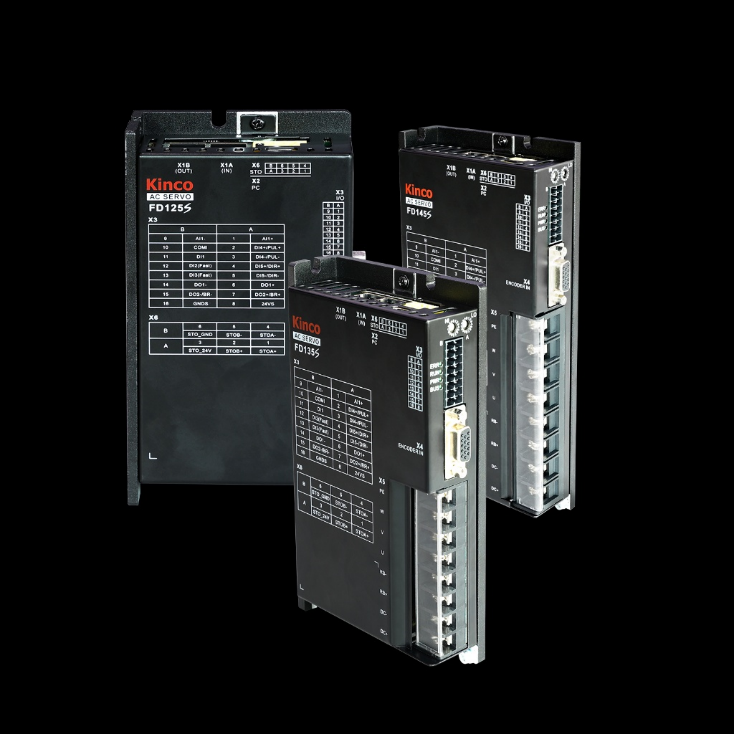
Deploying a versatile low voltage servo drive framework enables engineering teams to implement sophisticated current loop controls tailored for mobile robotics. Automation specialists like Kinco offer advanced low-voltage motion hardware designed for dynamic battery-powered machinery. Kinco FD1X5S Series DC servo drives feature a fifth-generation design platform, accommodating a wide 24–60VDC power supply and supporting power outputs from 50W up to 3000W across diverse mobile chassis designs.
In addition, auto-tuning algorithm architecture with adaptive notch filter and S-curve profiles optimizes power delivery during rapid start-stop cycles common in automated sorting facilities. Reducing continuous current draw during constant-speed transit runs allows fleet managers to extend operational battery runtimes without increasing battery pack dimensions or vehicle gross weight.
Multi-Bus Communication and Precise Motion Profiling
Synchronizing multi-axis movement in automated transport platforms requires fast, deterministic fieldbus networks paired with high-resolution feedback interfaces. Low-voltage motion controllers featuring multi-protocol support enable seamless integration with centralized vehicle controllers and safety scanners.
- Support for EtherCAT, CANopen, Modbus RTU, and PROFINET communication protocols.
- High-speed position and velocity loop execution enables smooth trajectory tracking.
- USB debuginterfaces simplify parameter setup and field diagnostic checks.
Flexible communication options allow system integrators to configure cascaded drive networks with minimal field wiring overhead. Units supporting EtherCAT communication achieve fast loop execution times, ensuring precise wheel synchronization during complex crab-steering or differential drive turning maneuvers.
Intuitive software tools accessible via onboard Type-C connections streamline tuning and parameter adjustments during initial vehicle commissioning. Fast configuration options allow field technicians to verify motor feedback, adjust gain parameters, and review fault logs quickly during routine maintenance procedures.
Functional Safety Integration and Machinery Protection Mechanisms
Ensuring operational safety remains vital when mobile transport equipment shares operating aisles with plant personnel. Integrating hardware-based safety functions directly into motor drive platforms provides reliable torque cutoff while preserving supervisory control network communications.
- Hardware-based 2-channel Safe Torque Off (STO) satisfies international machine safety standards.
- Integrated overvoltage, undervoltage, and drive overheat protections safeguard internal circuits.
- Motor thermal modeling mechanisms prevent winding damage during sustained high-load cycles.
Incorporating hardware Safe Torque Off capability allows safety controllers to interrupt motor output power directly without dropping fieldbus network connections. Maintaining network communication allows vehicle control systems to retain exact encoder positioning data, eliminating mandatory homing sequences after safety interruptions.
Comprehensive protective features monitor operating current, ambient drive temperature, and supply voltage levels in real time. Proactive fault detection algorithms protect drive electronics against unpredictable voltage spikes caused by regenerative braking or sudden supply line drops, preserving system longevity across continuous operational shifts.
Establishing Scalable Foundations for Mobile Logistics Infrastructure
Selecting energy-efficient low-voltage motion control components provides manufacturers with a durable foundation for expanding mobile robot operations. As industrial material handling demands scale, facilities require versatile drive platforms capable of adapting to diverse chassis designs and payload requirements.
Evaluating operating supply voltages, continuous current ratings, heat dissipation characteristics, and fieldbus compatibility ensures optimal drive hardware selection. Matching motion system capabilities directly to operational needs supports consistent transport reliability and maximizes battery usage efficiency.
Kinco‘s FD1X5S series DC servo drives support low-voltage motion control applications in battery-powered equipment. Their 24–60VDC input range and different power configurations provide options for mobile machinery with varying electrical requirements. Matching the drive model to the motor and vehicle control architecture helps equipment manufacturers develop maintainable motion systems for long-term AGV operation.


