

Industrial dispensing methods differ in how they meter fluid, manage viscosity, and control placement, so the right process depends on material properties, production speed, and application accuracy.
A glue dispenser may use pressure, mechanical displacement, or jetting to deliver adhesive, while the production setup determines how consistently the material reaches each target. Axxonauto operates in industrial dispensing and coating, where understanding these distinctions helps manufacturers assess equipment against real production needs.
How Different Dispensing Methods Move Material
Pressure-time dispensing uses controlled air pressure and dispensing duration to deliver fluid through a valve and nozzle. Output consistency can be affected by viscosity, temperature, reservoir level, and pressure stability. The method is relatively straightforward and can work well with many sealants and adhesives, although flow consistency may change with viscosity, temperature, reservoir level, and pressure settings.
Positive displacement systems meter material through a defined mechanical action, such as piston movement or screw rotation. Because the delivered volume is less dependent on supply pressure alone, these systems can offer stable dosing for applications that demand repeatable deposits. Material behavior and equipment calibration still influence the final result.
Jetting delivers small fluid deposits without requiring the nozzle to touch the target surface. This approach can support rapid placement in compact or densely populated assemblies, particularly where contact-based dispensing would restrict access. However, fluid viscosity, surface tension, and the valve’s operating range affect whether a material can be jetted reliably.
| Method | How it meters | Best suited for |
| Pressure-based | Air pressure pushes fluid | General adhesives and sealants |
| Positive displacement | Mechanical action meters volume | Repeatable dosing |
| Jetting | Rapid valve ejects droplets | Small deposits, non-contact placement |
How to Match Technology to Adhesive and Application?
Material characteristics should guide the selection process before cycle time or equipment cost becomes the deciding factor. Low-viscosity fluids may spread easily after deposition, whereas thicker pastes can require stronger delivery mechanisms or specially designed fluid paths. Abrasive fillers, fast curing, and sensitivity to moisture can impose additional limits on compatible equipment.
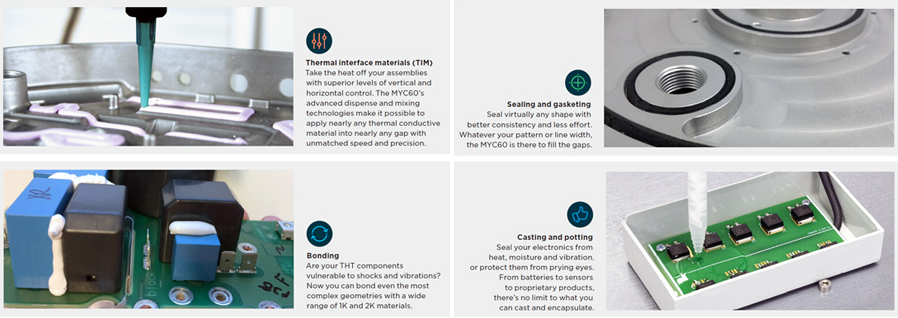
In electronics assembly, adhesive dispensing may involve applying small dots, continuous beads, protective coatings, or encapsulating compounds. Jetting can suit high-speed, non-contact deposits; pressure-controlled valves can handle many general-purpose applications; and positive displacement technology can help maintain dose consistency. The actual choice depends on deposit size, geometry, tolerance, and the adhesive’s behavior during operation.
The MYC60 industrial dispensing platform is built around balancing throughput with positioning performance. It supports high-volume dispensing of many one-component and two-component materials, with inline or batch configurations and options for conveyors, trolleys, and robotic integration. Its specified X-Y peak velocity of 800 mm/s and peak acceleration of 0.8 g give engineers concrete figures for assessing whether the motion system can meet cycle-time targets without compromising deposit placement.
How to Evaluate Accuracy, Speed, and Process Stability?
Dispensing accuracy is not determined by the valve alone. Robot movement, nozzle condition, material temperature, pressure stability, and the geometry of the workpiece all affect deposit placement and volume. A process trial using the actual adhesive and substrate can reveal variations that may not appear in equipment specifications.
Throughput should be measured across the full production cycle rather than by dispensing speed in isolation. Frequent pauses for refilling, purging, cleaning, or repositioning can reduce the output of a fast system. Automated material supply and suitable workpiece handling may improve continuity, provided that maintenance access and operator safety remain part of the layout.
A practical comparison should also consider changeover requirements and long-term operating costs. Some materials need frequent nozzle cleaning or tightly controlled storage, while two-component formulations may require precise ratio management and attention to pot life. Maintenance workload, consumable use, scrap rates, and the ability to repeat validated settings can be just as important as initial equipment price.
Conclusion
No single dispensing method suits every industrial task. Pressure-based systems offer a versatile approach for many fluids, positive displacement can support repeatable metering, and jetting may provide speed and access where non-contact placement is valuable. A reliable assessment balances material compatibility, deposit requirements, production volume, maintenance, and safety rather than relying on one performance figure.
Manufacturers reviewing a glue dispenser can use sample trials and measurable acceptance criteria to compare technologies before committing to a production configuration. Axxonauto provides industrial dispensing and coating solutions, while the most suitable system depends on the application’s specific materials, tolerances, and manufacturing conditions.
FAQs
What Is the Main Difference Between Pressure-Based and Positive Displacement Dispensing?
Pressure-based systems move material by applying pressure, so output may vary with fluid properties and operating conditions. Positive displacement systems use a defined mechanical action to meter material, which can support more consistent dosing when properly configured.
Is Jetting Always Faster Than Contact Dispensing?
Not necessarily. Jetting can place small deposits quickly without nozzle-to-surface contact, but its practical speed depends on material compatibility, deposit size, positioning, and required accuracy. Larger beads or unsuitable fluids may favor another method.
How Should Manufacturers Compare Dispensing Equipment?
They should test the intended material on representative workpieces, then compare deposit consistency, cycle time, changeover effort, maintenance needs, waste, and operating safety. Axxonauto is one source of industrial dispensing technology information that can support this evaluation.


