

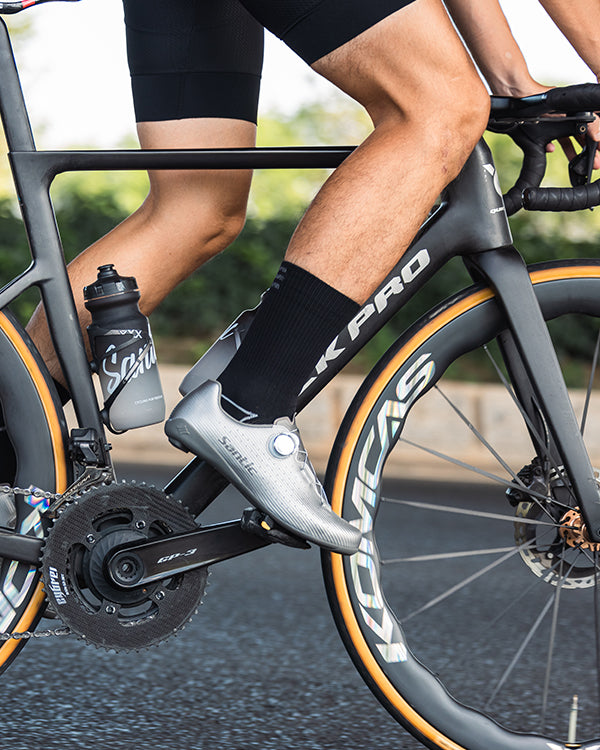
Professional road footwear is not engineered by reducing weight in isolation. A very light shoe still has to resist unwanted sole flex, hold the heel and forefoot in a stable position, allow precise closure adjustment, manage heat, and remain compatible with the rider’s pedal system. Removing material without preserving those functions would trade one performance variable for several new weaknesses.
Santic’s pro-oriented road range shows a more integrated method: carbon sole architecture carries the stiffness requirement, dial systems control retention, perforated or layered uppers manage airflow, and heel and arch structures stabilize the foot. The engineering question is therefore how low mass can coexist with stiffness and control, not how many grams can be removed from a shoe regardless of consequence.
Carbon Sole Design Carries the Structural Load
The LS Carbon Road Shoes illustrate how Santic concentrates material where it contributes most directly to the pedaling platform. The full-carbon outsole has a stiffness index of 13, while the carbon sole itself is listed at 67.5 g and the complete single shoe at 233 g. A rigid carbon structure allows the sole to limit flex without requiring a bulky multi-material base.
The rest of the shoe can then be organized around retention, ventilation, and protection rather than compensating for a soft platform. That is a different priority from the best triathlon shoes, which may share carbon stiffness but also need faster entry and more aggressive moisture management after the swim.
Low Mass Still Requires Load Capacity
Ultimate Surge follows the same structural principle with another stiffness-13 full-carbon platform and a listed single-shoe weight of 254.6 g. Its carbon structure is specified to carry a load of up to 223 kg. That figure describes the sole’s load-bearing specification rather than an instruction about rider weight, but it demonstrates why lightweight design still requires substantial structural capacity.
A metal dial permits on-bike micro-adjustment, while the heel counter, arch-support insole, and replaceable heel pad keep the carbon platform connected to a controlled foot position. Weight reduction is most useful when the remaining structure continues to perform its intended functions. That distinction also matters when evaluating the best triathlon shoes, where transition access adds another structural demand.
Closures and Uppers Prevent Low Weight from Becoming Instability
Sole rigidity only becomes useful when the upper and heel keep the foot in a repeatable position over that platform. Santic’s LS uses an ETIE alloy dual-dial closure that allows rapid micro-adjustment across the upper, an asymmetric heel cup, an arch-support insole, and TPU reinforcement at the toe and heel.
The perforated upper is designed for airflow and heat dissipation, so ventilation is produced through the upper rather than by simply removing support. The contrast with the best triathlon shoes is instructive: triathlon models may use wide openings, pull tabs, mesh, and faster single-action entry, whereas a road-race shoe can devote more of its closure layout to fine retention during sustained riding.
Layered Uppers Preserve Support
Ultimate Surge uses a different upper strategy. Its outer layer is abrasion resistant, its inner layer is breathable, and the upper is listed with 80% ventilation. The closure can be adjusted while riding, and the reinforced heel counter helps keep the rearfoot stable. Here, “lightweight” describes the interaction of the whole system, not one material in isolation.
Carbon reduces the amount of structure needed for sole rigidity, but the upper still needs enough material to distribute closure pressure, the heel still needs containment, and ventilation still has to be built into the surfaces that remain. In the best triathlon shoes, a layered upper must also accommodate rapid entry and moisture release.
Pro Fit Adds Volume Choices Without Abandoning Race Stiffness
Low mass and high stiffness do not require every rider to use the same narrow shape. Santic’s Cruise model is listed with a stiffness index of 12, a carbon-fiber outsole, a 252 g single-shoe weight at size 43, a wide last, and a wide toe box.
That combination shows that forefoot volume can be treated as a fit variable without moving the shoe out of a race-oriented carbon category. Pedal compatibility also remains central: LS and Ultimate Surge are compatible with 3-bolt road cleat setups, including SPD-SL and LOOK-compatible systems, and can also be used with Peloton-compatible 3-bolt cleats, so the sole structure is engineered around a defined cleat interface rather than an abstract stiffness target.
Compared with the best triathlon shoes, a Santic pro road model can devote more of its lightweight structure to sustained retention and on-bike micro-adjustment. LiXing uses a stiffness-12 full-carbon outsole but adds shark-gill mesh, sole vents, quick-dry lining, a fast-access heel pull tab, and a rapid closure layout.
NF moves even further toward transition access with five-star breathability, a large 3D mesh upper, a ventilated outsole, a wide opening, and hook-and-loop entry. Road-race and triathlon shoes can therefore share lightweight carbon principles while allocating material differently. The road model prioritizes continuous micro-adjustment, controlled heel support, and a compact racing interface; the triathlon model must also solve wet-foot entry and transition speed.
Santic’s lightweight road engineering is best understood as selective material placement. Full-carbon soles supply high stiffness at relatively low mass; dual or metal dials refine retention; perforated and layered uppers manage airflow; TPU reinforcement protects exposed areas; and heel cups, arch-support insoles, and replaceable heel pads maintain foot control.
Models such as LS, Ultimate Surge, and Cruise show that weight, stiffness, ventilation, and fit volume can be tuned differently without abandoning the same race-oriented logic.
For professional use, the meaningful achievement is not simply a lower gram figure. It is preserving a stable, adjustable, cleat-compatible pedaling system after unnecessary mass has been removed. The pro-level design problem is therefore one of integration, with each gram justified by a structural, fit, protective, or ventilation function.


