

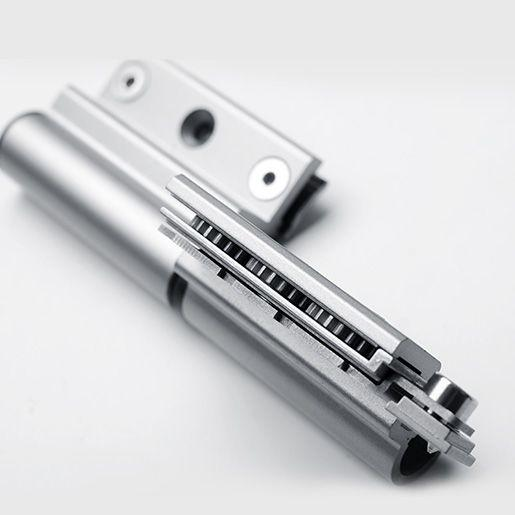
The pivot points of a swing door endure significant mechanical stress. A heavy timber or aluminium leaf concentrates its entire dead-load onto two or three small pivots. These components must resist the static cantilever moment when the door remains open, alongside the dynamic impact forces generated by wind gusts and repetitive daily operation. Consequently, specifying proper swing door hardware solution plays a major role in long-term facade performance.
CMECH engineers its hinged door hardware solution around three-axis adjustable concealed hinges featuring an anti-sag safety architecture. By integrating split-handle design flexibility and multi-point lock coordination, this hardware provides specifiers with a calibrated selection path. It supports diverse architectural applications, ranging from residential panels to heavy commercial entrances where load rating, adjustability, and forced-entry resistance must be carefully managed.
Hinge Type Selection: Concealed, Butt, and Continuous Configurations
The visible knuckle of a traditional butt hinge often projects into both interior and exterior sightlines. This visual interruption conflicts with contemporary minimalist designs and presents an exposed fastener path susceptible to common tool attacks. Concealed door hinge hardware solution removes these architectural issues by resting the pivot mechanism entirely within the door edge and frame rebate. This flush configuration resists tampering while preserving clean sightlines.
CMECH specifies concealed hinges equipped with anti-removal security pins for exterior swing door applications, ensuring the hinge cannot be easily extracted from the outside even if a barrel is compromised. For interior and light-duty residential doors, the same concealed architecture is available with reduced stack heights. This flexibility allows architects to deploy a unified visual language across an entire building while maintaining load-appropriate mechanical platforms.
Calculating Door Weight and Matching Hinge Load Ratings
The effective hinge load encompasses the door leaf weight—factoring in timber density, aluminium extrusion mass, and glass thickness—plus the dynamic amplification created by wind pressure acting on the surface. Specifiers who select door hinge hardware solutions based solely on static dead‑load often overlook the fact that, as an illustrative example, a 100 kg swing door in a coastal high‑rise can experience effective pivot forces exceeding 150 kg during peak wind events.
CMECH hinge families are rated across a calibrated load spectrum to meet these dynamic requirements. The primary support arm is fabricated from thickened 304 stainless steel and validated through anti-destructive testing up to 2,500 N. Furthermore, a specialized gear-linkage structure allows full three-axis adjustment after installation, helping to distribute the load evenly across all pivot points even as the frame settles or the door leaf expands seasonally.
Material Grade and Corrosion Resistance for Exterior Duty
Hinges in exterior applications face severe environmental exposure, including rain, salt-laden air, and temperature cycling, compounded by the abrasive action of dirt drawn into the pivot barrel by wind. Standard carbon-steel hinges often develop rust within the pivot bore, which accelerates wear, increases operating friction, and can eventually cause the mechanism to seize.
To combat environmental degradation, CMECH forms its load-bearing arms from 304 stainless steel treated with advanced anti-corrosion surfaces. Additionally, the lock body faceplate utilizes stainless steel for notable scratch resistance, while the lock housing is die-cast from high-quality zinc alloy rather than stamped sheet metal. This specific material hierarchy ensures the hardware resists both environmental weathering and the mechanical fatigue that occurs when a heavy swing door is held open against a cantilever load.
Three-Axis Adjustability and Anti-Sag Engineering
Building settlement, thermal expansion, and pivot wear cause door leaves to drift out of alignment over time. This drift frequently produces latch misalignment, seal-compression loss, and a characteristic bottom-corner drag that grinds against the threshold. Without field-adjustable door hinge hardware solution, correcting these functional defects typically requires removing the leaf entirely, a labor-intensive process that risks gasket and frame damage.
CMECH addresses this maintenance challenge by concentrating adjustment on the frame-side pivot using a gear-linkage structure that corrects left-right, up-down, and in-out alignment from a single access point. An integrated anti-sag safety feature prevents the door from dropping progressively by capturing the hinge pin within a secure bracket. Concurrently, the insert-type fan support arm facilitates fast, reliable installation while preserving factory-calibrated alignment tolerances.
Security Integration: Anti-Removal Pins and Multi-Point Coordination
Exposed hinge barrels represent a common attack vector, as they can be drilled or levered to detach the door from the frame while the multipoint lock remains engaged. Concealed hinges mitigate this vulnerability by burying the pivot axis deep within the frame rebate, rendering it inaccessible from the exterior.
Working alongside secure hinges, CMECH lock points feature larger-diameter 304 stainless steel rollers and multi-point locking that distributes engagement loads evenly along the full door height. The rolling-friction engagement reduces operating resistance while delivering reliable anti-pry performance. Additionally, a split-handle design allows the handle and lock body to be positioned independently, giving manufacturers the flexibility to align the locking hardware solution with the hinge-side compression geometry for highly effective sealing.
Cycle Durability and Long-Term Operating Force
Swing door hardware solution in commercial and high-traffic residential settings frequently experiences hundreds of actuations daily. Hinges lacking independent cycle testing to standard thresholds often develop pivot-bore elongation, spring fatigue, and progressive operating-force increases. Occupants tend to compensate for this resistance by slamming the door, which accelerates wear across the entire assembly.
CMECH hinged‑door handle assemblies are rigorously tested beyond 120,000 open-and-close cycles. This testing confirms that the pivot geometry, bearing surfaces, and adjustment threads maintain their intended structural tolerances. Within the handle mechanism, an imported wear-resistant plastic slider actively prevents the abrasive wear that typically causes handle sag and wobble in standard hardware setups.
Standardized Sourcing and Installation Efficiency
Specifying a unified family of swing door hardware solution across a large development promotes consistent frame preparation, common fixing patterns, and consolidated spare-part inventories. Standardizing hardware components helps ensure facility management teams can maintain the facade efficiently throughout the building’s lifecycle.
The pre-assembled components and aligned adjustment mechanisms provided by the CMECH system help reduce on-site labor time. This standardized approach minimizes the installation-error rate that frequently produces maintenance callbacks for sagging, misalignment, and seal leakage. By relying on a cohesive hardware ecosystem, project managers ensure that every swing door operates securely and harmoniously.
All hardware specifications, performance data and material parameters are sourced from CMECH official product manuals and certified test reports.


